

Walk into any pet shop today and you’ll hear the same advice: “Cats drink more from fountains.” And sometimes they do. But what’s rarely explained is what happens to the water after day one… and day two… and day five. Because hydration is important — but hygiene is just as important. This article isn’t about banning fountains. It’s about understanding the microbiology of standing water in a real household environment.
What Happens Every Time a Cat Drinks
A cat doesn’t drink with a clean spoon — it drinks with a living mouth.
Each lick transfers:
- saliva proteins
- food particles
- oral bacteria
- environmental microbes
Within hours, microorganisms attach to surfaces and begin forming a biofilm — a microscopic layer that sticks to walls, pipes, pumps and filters. Once established, biofilm cannot be removed by rinsing. It requires mechanical cleaning.
Studies of animal water containers consistently detect bacteria such as:
- E. coli
- Pseudomonas
- Campylobacter
- Salmonella
These don’t automatically cause disease in healthy cats — but they dramatically increase risk in:
- kittens
- senior cats
- FIV/FeLV cats
- cats with dental disease
- cats prone to urinary problems
The “Pink Slime” Many Owners Notice
Many Irish cat owners report a reddish-pink residue in fountains — especially around pumps and filters. This is almost always: Serratia marcescens. An airborne environmental bacterium that thrives in damp, nutrient-rich environments. It feeds on organic material from saliva and food residue.
Why it appears quickly in fountains:
- stagnant water
- warm pump temperature
- chlorine removed by carbon filters
- constant moisture
For healthy pets it’s usually harmless — but in immunocompromised animals it can cause opportunistic infections. Its presence is not unusual. But it is a signal: the system needs cleaning immediately.
Temperature: The Hidden Factor
Fountain motors gently heat water. Most bacterial growth accelerates between 20–37°C — exactly the range created inside a running fountain. Between cleanings, the system becomes: a circulating nutrient broth.
The Maintenance Reality
To remain hygienic, fountains require:
- daily water replacement (not topping up)
- weekly full disassembly
- scrubbing of internal channels
- pump cavity cleaning
- filter replacement
Without this routine, contamination accumulates — not because fountains are bad, but because they are complex. A simple bowl becomes dirty. A fountain becomes colonised.
What Research Shows
Multiple studies on animal drinking containers and water systems demonstrate:
• pet water containers rank among the most contaminated household items
• stagnant water promotes bacterial growth
• biofilm persists inside automated watering systems
• warmer water increases microbial load
The conclusion is consistent across veterinary hygiene research: fresh, frequently replaced water is the primary safety factor —not the delivery method.
Ok… so what’s the right choice?
There isn’t one perfect system for every home — but there are safer habits. The goal isn’t choosing sides. The goal is protecting cats.
If You Use a Bowl
Simple works very well.
Best practice:
- ceramic or glass bowl
- wash daily with hot water
- refill morning & evening
- place away from food and litter
- provide multiple water locations
Many cats drink more when water feels separate from food — a natural instinct.
If You Use a Fountain
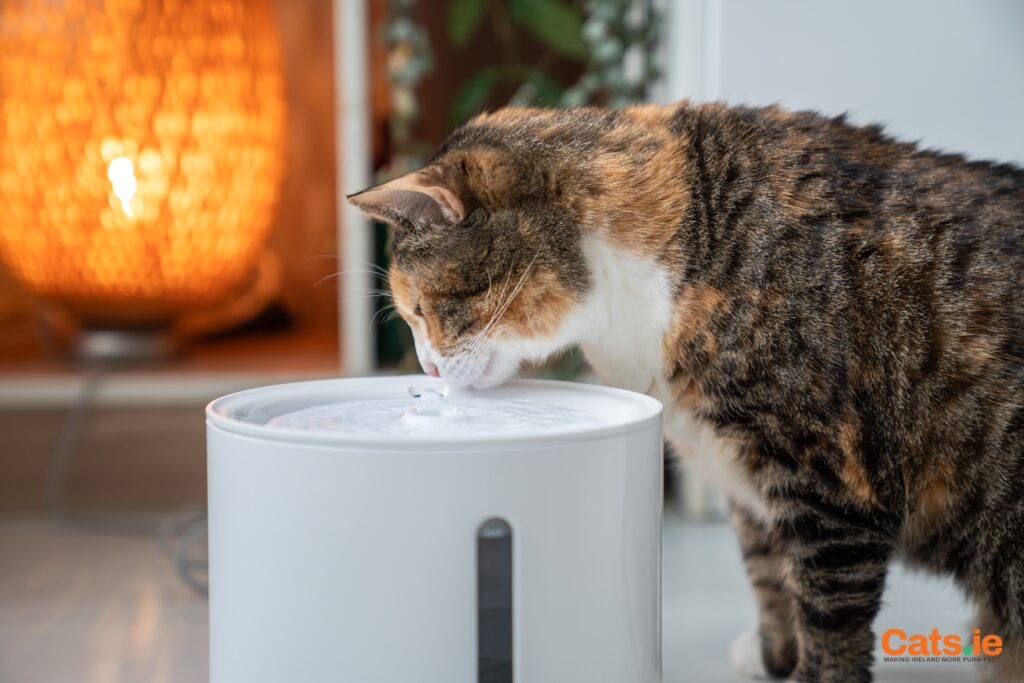
A fountain is fine — if treated like a kitchen appliance, not decoration.
Minimum care routine:
- change water daily
- full cleaning weekly
- clean pump chamber
- replace filters on schedule
- remove any pink residue immediately
For kittens, seniors, or FIV cats → clean more often.
The Most Effective Hydration Method
Add water to food. Even 1–2 tablespoons per meal increases total intake far more than encouraging drinking alone. Wet diet + added water closely matches natural hydration.
When to Pay Attention
Contact your vet if you notice:
- sudden increase in drinking
- avoiding water
- strong urine odour
- straining in litter tray
- recurring UTIs
Hydration behaviour is often an early health signal.
The Takeaway
Fresh water matters more than moving water. Clean water matters more than clever water. Consistency matters more than equipment. Cats don’t need complicated solutions — they need reliable ones.
Bowl or fountain in your home? We’d genuinely like to hear what works for your cat.